Portfolio / 2026 Efficient inference · Sparse attention · Diffusion LLMs IIT Roorkee

Aryan Sood.

I research how to make long-context language models cheaper to run — KV-cache compression, sparse and distributed attention, and the dynamics of diffusion LLMs.

Scroll
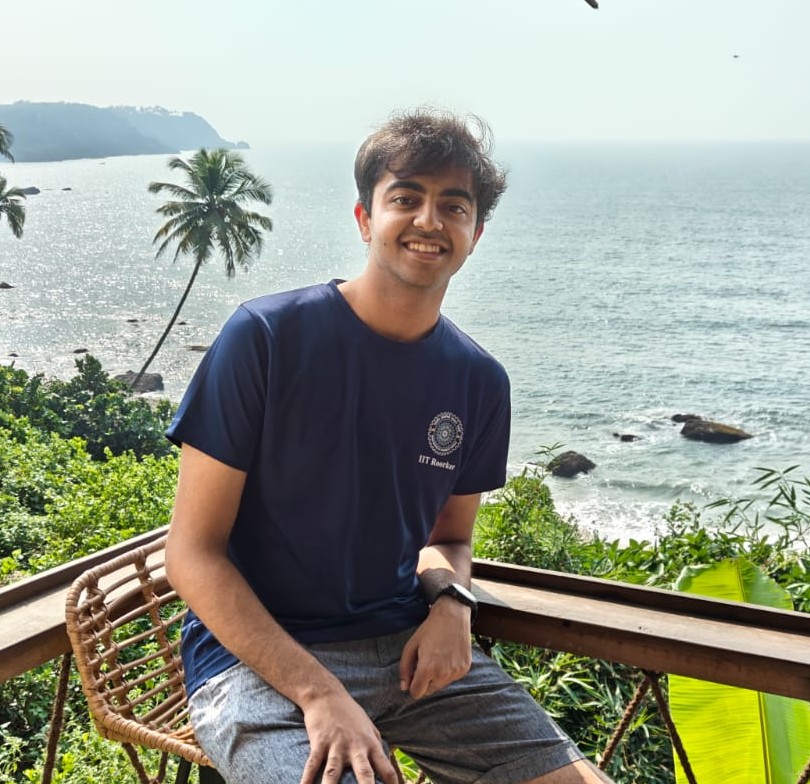
Portrait of Aryan Sood B.Tech EE ’28 · IIT Roorkee

( 01 — About )

Electrical Engineering undergraduate at IIT Roorkee, working where systems meet models. I build methods that let language models read longer contexts for less compute — and I care that they stay inspectable, reproducible, and usable in real workflows.

Now
ML Engineer Intern, Simplismart
Before
AI Research Intern, Lexsi Labs
Group
Core member, Vision & Language Group, IITR
Based
Gurugram, Haryana, India
7papers & preprints
7accepted · 1 Findings · 1 oral
4internships
1519AIR, JEE Advanced

( 02 — News )

Recently

  1. Oct 2026

    Are You Sure You're Sure? accepted as an oral at the JUDGe Workshop, NeurIPS 2026.

  2. Oct 2026

    BRIEF and Underscoring the Problem accepted at the Long-Context Foundation Models (LCFM) Workshop, NeurIPS 2026.

  3. Sep 2026

    Joined Simplismart as an ML Engineer Intern, working on pipeline- and kernel-level inference optimisation.

  4. 2026

    Dropping the Anchor (Pulsar Attention) accepted to Findings of EMNLP 2026.

  5. Aug 2026

    Joined Lexsi Labs as an AI Research Intern, working on long-document generation (BRIEF).

  6. 2026

    Lost in Interpolation accepted at the Non-Autoregressive LM Workshop, COLM 2026.

  7. Mar 2026

    Started an independent research internship with Shantanu Acharya (Research Scientist, NVIDIA) on distributed long-context inference.

  8. 2026

    More Than a Quick Glance accepted at the ICBINB Workshop, ICLR 2026.

  9. 2026

    Don't Look Up (Every Token) published in the ICLR 2026 Blogpost Track.

  10. Feb 2026

    Preprint of LASER-KV released on arXiv.

( 03 — Research )

Publications

All publications & BibTeX
01 Dropping the Anchor: Statistical Context Summarization for Distributed Systems via Pulsar Attention ★ EMNLP 2026 Findings Developed Pulsar Attention for distributed long-context inference, replacing static anchor duplication with content-aware statistical summaries and reporting up to 4.7% accuracy gain over dense attention, 6.1% over Star Attention, and 3.3x lower Phase-1 FLOPs. Also accepted at the AdaptFM Workshop on Resource-Adaptive Foundation Model Inference, ICML 2026. 02 Are You Sure You're Sure? Two Confounds in a Sycophancy Benchmark ★ NeurIPS 2026 · Oral Audits SycEval and shows two template confounds: naming a target answer raises the follow rate by 14.1–49.5 pp and, once controlled, reverses the reported timing effect on three of five model conditions; relocating the output-format instruction flips its effect across models. Closes with three checks benchmark authors can run on their own templates. 03 More Than a Quick Glance: Overcoming the Greedy Bias in KV-Cache Compression ICLR 2026 Introduced LASER-KV, a KV-cache compression method achieving up to 10% higher accuracy at 128k context over greedy pruning baselines via block-wise accumulation and Exact-LSH sampling. 04 Lost in Interpolation: Why Predictive Feedback Fails in Diffusion Language Models COLM 2026 Introduced spherical soft-masking for diffusion LLMs, replacing Euclidean LERP feedback with SLERP over Fréchet means to mitigate embedding norm collapse during MDLM fine-tuning. 05 BRIEF: Bounded-Context Regeneration of Long Documents with Verifiable Structural Topology NeurIPS 2026 Regenerates long legal and financial documents one clause at a time from short structural briefs (number path, required terms, cross-references), never showing the generator source prose. Keeps cross-reference fidelity near 0.98 with a near-constant ~86-token maximum prompt, and improves verifiable section and cross-reference topology over one-pass generation on CUAD and EDGAR EX-10. 06 Underscoring the Problem: Why Softpick Fails at Initialization NeurIPS 2026 Reframes softpick's failure at scale as a normalization problem by splitting its denominator into forward and backward roles. Traces the failure to initialization (rows with zero positive mass and gradient norms above 1012) and identifies a stop-gradient operator that trains from scratch and, at 230M parameters, matches softpick on quantization with fewer dead heads and better passkey retrieval. 07 Don't Look Up (Every Token): Escaping Quadratic Complexity via Patterns and Algorithms ICLR 2026 Surveyed sparsity-based efficiency methods for transformers, organizing them into a unified taxonomy distinguishing static structural patterns from dynamic, attention-driven approaches.

★ Highlight · EMNLP 2026 Findings

Dropping the Anchor: Statistical Context Summarization for Distributed Systems via Pulsar Attention

Star Attention prepends a full copy of block 1 to every GPU; Pulsar sends a 64-token sink plus Max-IDF chunks (rare tokens) from earlier blocks, then discards that prefix and merges the query globally.

Interactive explainer

( 04 — Experience )

Internships

Full timeline
  1. September 2026 – Present
    Inference Optimisation

    ML Engineer Intern

    Simplismart

    Working on LLM inference optimisation for production serving, with research spanning both the pipeline level and the kernel level.

    LLM inference / GPU kernels / Profiling / Model serving

  2. August 2026 – September 2026
    Long-Document Generation

    AI Research Intern

    Lexsi Labs

    Worked on long-document generation and led the research project BRIEF (Bounded Regeneration In Exact Form), which regenerates long legal and financial documents clause by clause from short structural briefs derived from a reference graph.

    Long-document generation / Graph-conditioned generation / CUAD / EDGAR

  3. March 2026 – May 2026
    LLM Research

    Independent Research Intern

    Shantanu Acharya, Research Scientist at NVIDIA

    Designed and implemented Pulsar Attention, a distributed long-context LLM inference framework that replaces static anchor duplication with content-aware statistical context summaries.

    Distributed attention / FlashAttention / RULER / BABILong

  4. March 2026 – May 2026
    Computer Vision

    Computer Vision Intern

    Auric AI Labs

    Created an end-to-end synthetic EO data generation pipeline for object-detection models using controlled top-view renders from 3D military-object assets.

    BlenderProc / Meshy AI / RemoteCLIP / Synthetic data

( 05 — Projects )

Things I’ve built

All 13 projects
01 LLM Evaluation 2026
16K context sweeps · 5 adversarial families

Long-Context Adversarial Eval Harness

Source-grounded long-context fact-QA harness with length and position sweeps, distractor and multi-hop cases, exact-span hallucination checks, and calibration reports.

vLLM · Modal · uv · pytest Code
02 Civic ML 2026
A* road-aware patrol planning

ParkWatch

Parking-enforcement intelligence for Bengaluru traffic teams: GraphSAGE hotspot forecasting, patrol sequencing, and exportable action plans.

Next.js · FastAPI · GraphSAGE · Mappls Code
03 Research Systems 2026
100K+ arXiv papers indexed

Research Corpus Agent

Multi-agent literature RAG with planner, retriever, analyst and critic agents, hybrid retrieval, and figure/table understanding.

BGE · BM25 · ColBERT · RRF Code
04 Signal ML 2026
0.971 avg. F1, 5-fold CV

GNSS Anti-Spoofing Detection

Early-fusion Transformer over 112-dim multi-channel GNSS sequences with physics-informed features.

Transformers · Feature engineering
05 Computer Vision 2025
+10pt mAP@0.5 (35% → 45%)

GATE-IR

Gated thermal perception: weather-specific enhancement routed before lightweight YOLO detection, at near-YOLO latency.

Thermal imaging · YOLO · Gating Code
06 Diffusion LLMs 2025
78% GSM8K, up from ~60%

ASMS: Adaptive Semantic-Momentum Sampling

Diffusion-LLM decoding with confidence momentum, semantic hysteresis and entropy-aware control against hallucination lock-in.

dLLMs · Remasking · Decoding Code
07 Efficient Inference 2025
1.7× decoding speedup, 97% QA retained

FOCUS: Sparse Token Selection

A lightweight neural token pruner trained on attention distributions that drops 60%+ of context before inference.

Token pruning · Selective attention
Archive See all 13 projects

( 06 — Writing )

Blogs

All 4 posts

( 07 — Education & Recognition )

Background

2024 — 2028

Indian Institute of Technology Roorkee

Bachelor of Technology, Electrical Engineering

8.175/ 10 CGPA · 3.538 / 4*

* US-scale conversion via Scholaro methodology.

  • 2025

    2nd Place, PixelPlay — campus-wide computer vision hackathon

  • 2025

    Institute Research Day — project selected via the Tinkering & Mentoring program

  • 2025

    Flipkart Gridlock 2.0 — top 400 of 10,000 teams, round 2

  • 2024

    JEE Advanced AIR 1519 · JEE Main AIR 2912